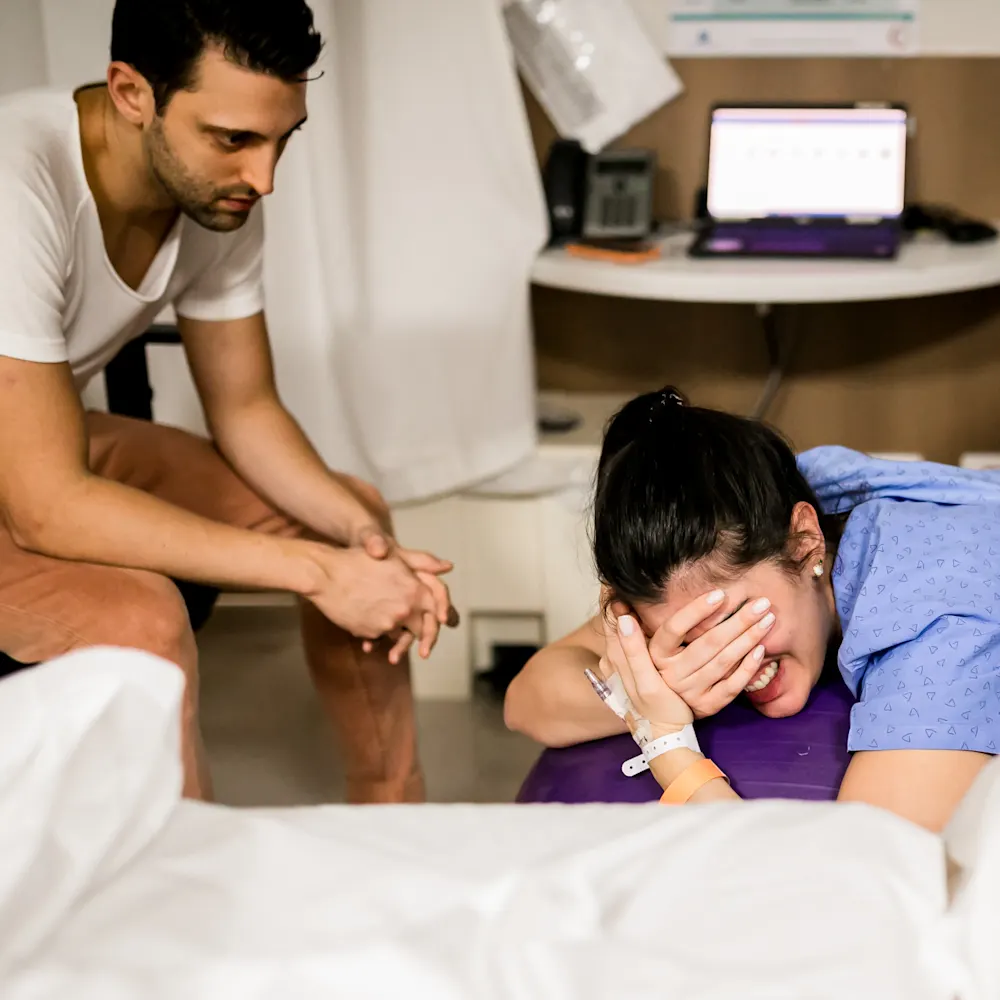
What do contractions feel like? Where you'll feel them
Updated Oct 10, 2026
Up-to-date



Is this finally it? It's one of the most common questions in late pregnancy, and the sensations that come with contractions don't always match what you pictured. Some parents feel a dramatic squeeze across the belly. Others notice a dull ache in the lower back that comes and goes. Both are common!
In this article, we’ll cover what contractions actually feel like, where you're likely to feel them, and how to tell the real thing from a practice run (as if pregnancy hadn't handed you enough guessing games already).
What do contractions feel like overall?
A contraction is your uterus tightening and then releasing. Expecting parents describe that sensation in a lot of different ways, such as [1, 2]:
A firm squeeze that spreads slowly across your belly, like a tightening band squeezing across your stomach and then releasing slowly
A low, achy discomfort similar to a period cramp
A pushing or squeezing sensation across your uterus or abdomen
Sometimes a tightness that starts at the top of your uterus and moves its way down
Your whole belly going hard and tight to the touch, almost like a flexed muscle, then softening again a minute or so later
As contractions progress, they will become difficult to talk or move your body during. (This can be a helpful distinguisher between real labor contractions and Braxton Hicks.)
Where do you feel contractions?
The short answer to this: it depends. Contractions can show up in one spot or several at once. Most parents describe feeling contractions in multiple places rather than just one.
Common locations for contractions can include:
Lower abdomen or lower belly: This is the spot most people expect, and it's where many expecting parents feel the tightening first.
Lower back: Some contractions are felt mainly as back pain, especially if the baby is positioned facing forward. This is often called "back labor".
Pelvis, hips, or vaginal pressure: As labor progresses, contractions often bring a heavier, downward pressure in the pelvis or hips.
It's common for the sensation to move around, too. A contraction might start as a dull ache in the back, wrap around to the front, and finish as pressure low in the pelvis [3].
Do contractions feel like period cramps?
Yes, contractions can feel similar to menstrual cramps, at least at first. Both can feel like a cramping or aching pressure low in the pelvis, which is part of why they’re easy to second-guess.
The difference shows up in the pattern. Period cramps tend to stay fairly constant. Contractions build and release in a rhythm: they tighten, peak, and ease off completely between episodes, and that rhythm tends to intensify and get more regular over time as labor begins.
If what you're feeling remains intermittent, it's more likely cramping or Braxton Hicks, not labor. If it comes in waves that are getting stronger and closer together, it could be time to time your contractions to see if there is a pattern and if it’s a sign of labor.
What do early contractions feel like versus active labor?
Contractions don't usually start at full intensity. They typically get stronger and more frequent over hours, sometimes days, as labor progresses.
Early tightening in the weeks before labor is often Braxton Hicks — the "practice" contractions many parents confuse with the real thing. Braxton Hicks tend to feel milder and more irregular than true labor.
Stage | What it feels like |
Braxton Hicks | Mild tightening across the belly, often painless or just uncomfortable, and irregular in timing |
Early labor | Cramping or tightening that comes and goes at irregular intervals, similar to period cramps, gradually becoming more consistent in frequency and duration |
Active labor | Stronger, closer-together squeezing, often paired with back or pelvic pressure, that's hard to talk or breathe through |
Other sensations that can come with contractions during active labor
The tightening itself usually isn't the only thing you'll notice. As labor moves along, a handful of other sensations tend to tag along for the ride. Most of them are just as common as the tightening itself, such as:
Pressure or fullness in the pelvis, like something is pushing down
Nausea, an upset stomach, digestive changes, diarrhea, or even vomiting, which can range from mild queasiness to more noticeable stomach upset, especially during transition
A feeling that takes your breath away during the strongest part of a contraction, especially in active labor
Leg cramping or shakiness, particularly once contractions get stronger and closer together
A hot, flushed feeling that's sometimes followed by chills once the contraction passes
A dull ache radiating into the hips or thighs, alongside the tightening in the belly or back [4]
Sweating or clamminess, even in a cool room, as your body works through each contraction [5, 6]
Can you feel contractions in unusual places? (legs, hips, chest, upper back)
Referred sensations from the surrounding muscles and nerves can show up in the legs, hips, upper back, or even as tightness in the chest during a strong contraction [7]. This is less common, but it's not unusual either.
That said, the core feeling of a contraction is almost always centered in the abdomen, lower back, or pelvis [8]. If you notice a sensation elsewhere and it isn't accompanied by tightening in the belly, you can always mention it to your provider for additional clarification.
How to know if you're really having contractions
Sensation alone can be a confusing guide, especially the first time around. A few practical signs to check for [9]:
The sensations get closer together and more intense over time
They don't ease up with rest, hydration, or a change in position (Braxton Hicks often do)
The sensations shift from uncomfortable to painful as labor progresses
They follow a regular pattern you can track, with a clear start and end to each one
Time your contractions for reassurance
At this stage of pregnancy, how a contraction feels may be hard to read. You can’t tell whether it’s Braxton Hicks or the real deal from one contraction alone. Instead, you’ll need to look at how often the contractions are happening and how long each lasts. Track that for an hour or two and you'll have a better answer than you'd get trying to interpret each contraction.
That's what the Contraction Timer in the Huckleberry app is made for. Tap once when a contraction starts and again when it ends. From there, the timer tracks the space between contractions, how long each one lasts, and can give you a clearer picture of whether the pattern is progressing toward active labor or holding steady.
Plus, when you're on the phone with your provider trying to decide whether it's time to head in, you can pull up your Contraction Timer log instead of relying on memory.
When to call your provider about what you're feeling
Call your provider, regardless of how mild the sensation seems, if you are experiencing contractions or have questions about contractions and you:
Are before 37 weeks of pregnancy
Have had a previous C-section
Are having a planned C-section
Have had a cervical cerclage [10]
A few symptoms need faster action and are called Urgent Maternal Warning Signs. If you have any of the following warning signs, skip the phone call and head to the hospital if you notice [11]:
Vaginal bleeding or fluid leaking
Your baby moving noticeably less than usual
Pain that stays constant and severe, rather than easing between contractions
A severe headache or sudden changes to your vision
Feeling dizzy or fainting
A fever of 100.4°F (38°C) or higher
Chest pain, trouble breathing, or a racing heartbeat
Severe pain in your abdomen
Pain, redness, or swelling in one leg or arm
Don't hesitate to call your healthcare provider if you're not sure about whether you're in labor or experiencing Braxton Hicks contractions. That's exactly what they're there for.
Share article:

Note: The content on this site is for informational purposes only and should not replace medical advice from your doctor, pediatrician, or medical professional. If you have questions or concerns, you should contact a medical professional.
15 Sources
Share article: