First night home with newborn: A complete survival guide
Updated Sep 03, 2026
Up-to-date
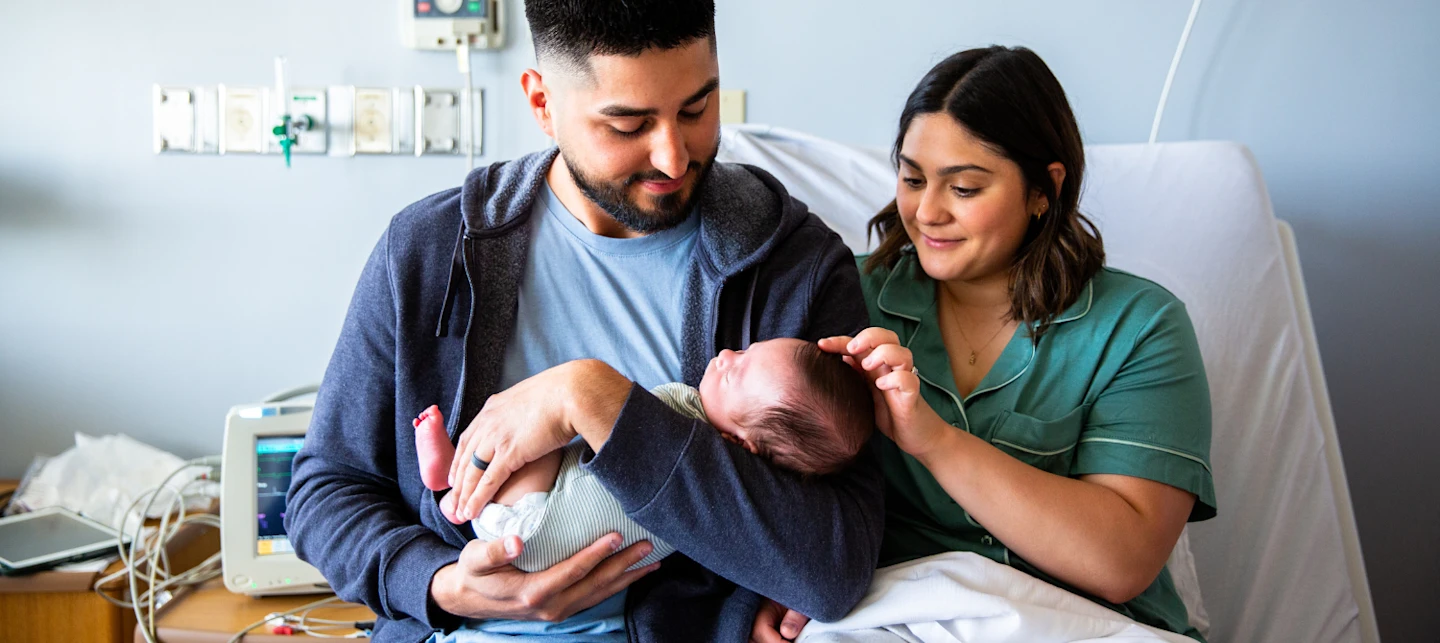


Of course, the first night at home with a newborn will look different for every family. Whether you're coming home after a hospital birth, settling in after a home birth, welcoming a baby home from the NICU, growing your family through adoption, or arriving here by another path, some parts of this may feel more relevant to your experience than others.
Take a deep breath. You’ve got this! And we’ve got you. This guide covers everything you need to know to survive (and find the joys in) your first night home: what to expect, how to prepare, how to keep your baby safe, and when to call the doctor.
What to expect your first night home with a newborn
Here's an honest preview of what's waiting for you on the other side of that front door, sweet little one in tow.
Normal newborn sleep patterns
Newborns are champion sleepers — just not always at the times you'd prefer. Most newborns sleep 14 – 17 hours in a 24-hour period, but that sleep is spread across the day and night in short stretches. [1] During the first few weeks, babies wake frequently because they have small stomachs, need to eat often, and haven't yet developed a mature internal clock that helps distinguish day from night.
But this stage is temporary. As your baby grows, their feeding patterns mature, and their internal clock develops, sleep gradually begins to consolidate into longer stretches.
Feeding frequency
Your newborn has a stomach that starts out roughly the size of a cherry, which means it empties quickly. By the end of the first week, it’s about apricot size. Expect to feed every 2 – 3 hours around the clock, which works out to 8 – 12 feedings per 24 hours. For breastfeeding parents, frequent feeds in the early days also play a crucial role in establishing your milk supply, so those nighttime sessions are doing double duty. Formula-fed babies may stretch slightly longer between feeds as they get older, but the general newborn rhythm is the same.
The sounds (and smells) of a newborn
Newborns are surprisingly noisy. Grunting, squeaking, snuffling, startling — all of this is normal, even in the middle of the night when you’re “sleeping” (but not really). Their digestive systems are working hard and their nervous systems are still maturing. You will also become intimately acquainted with a variety of diaper situations at all hours of the day and night.
4 tips for preparing for baby's first day home
The more you set up in advance, the less you'll be scrambling at 2 AM. It's like building the stage before the show opens. Once the curtain rises and your little star arrives, you can focus on those first few moments with your baby.
Tip #1: Set up a safe sleep space in your room
It can be helpful to have your baby’s safe sleep space set up ahead of your first night together. AAP guidelines recommend room-sharing (not bed-sharing) for at least the first 6 months. [2] A bassinet or bedside sleeper works well for this. AAP guidelines also call for a firm flat mattress, free of pillows, bumpers, blankets, and stuffed animals.
Tip #2: Stock your feeding supplies
Gather your nursing pillow, nipple cream, breast pads, and a large water bottle for yourself if breastfeeding. If formula feeding, having bottles sterilized and formula measured out in advance can be useful, too. If you're pumping, keep your pump charged and ready, along with collection bottles, sterilized pump parts, and storage bags if needed. Your future self will be grateful to have everything within arm's reach of your feeding spot.
Tip #3: Set up easy-access changing stations
A fully stocked station in the bedroom means fewer midnight trips across the house. Keep diapers, wipes, a changing mat, diaper cream, and a spare outfit (or three) within arm’s reach. Bonus points for a hands-free trash can nearby.
Tip #4: Prepare the environment
A white noise machine or app, a dim nightlight (enough to see baby without jolting everyone awake), and a comfortable chair or feeding spot make nighttime care more manageable. Think dark, quiet, calm.
First night home checklist (table)
Category | Items to have ready |
Sleep | Bassinet/crib with firm flat mattress, fitted sheet (no extras), swaddles |
Nursing/pumping | Nursing pillow, nipple cream, bottles, pump supplies, large water bottle for parent(s) |
Formula | Bottles, formula (if using), large water bottle for parent(s) |
Changing | Diapers, wipes, changing pad, diaper cream, spare outfits |
Environment | White noise machine or app, dim nightlight |
Support | Phone numbers saved (medical provider, lactation consultant, perinatal mental health therapist), trusted family/friend on call) |
Newborn first night home: Common emotional and physical realities
Here's the part that doesn't make it onto the greeting cards: the first night home can be emotionally complex in ways that catch even the most prepared parents off guard. You're not doing it wrong if it doesn't feel like a movie montage.
Hormonal shifts
For birthing parents, the dramatic postpartum hormone drop (estrogen and progesterone plummeting after delivery) can trigger what's commonly called the "baby blues," characterized by weepiness, mood swings, and emotional sensitivity in the first 2 weeks. [3] This is not postpartum depression; it's a biochemical reality that affects the majority of new parents. Knowing it's coming makes it slightly less alarming when it arrives.
If symptoms do continue past the first 2 weeks, it’s worth reaching out to your medical provider or a licensed perinatal therapist for support. It could be a sign of a perinatal mental health disorder, such as anxiety, depression, or OCD. These mental health struggles can happen in both birthing and non-birthing parents.
Physical recovery
Whether you had a vaginal birth or a cesarean, your body has been through something significant. Pain, soreness, perineal discomfort, uterine cramping (especially during breastfeeding), and general exhaustion are all par for the course. And the physical exhaustion applies to non-birthing parents, too! This is not a time for powering through without rest.
Emotional vulnerability
Feeling overwhelmed, tearful, anxious, or scared your first night home doesn't mean you're not ready to be a parent. The love, the responsibility, the sheer magnitude of this tiny person's needs — it's a lot to hold. Give yourself the same patience and gentleness you're giving your new little one.
First night with newborn: Safe sleep and crib setup
When you're running on zero sleep and pure adrenaline, safe sleep practices can feel like a lot to remember. But these are evidence-based guidelines that greatly reduce the risk of SIDS (Sudden Infant Death Syndrome) and other sleep-related infant deaths.
AAP safe sleep guidelines suggest: [4]
Choosing a firm, flat sleep surface
Always place your baby on their back
Keeping the sleep space bare without pillows, bumpers, stuffed animals, or blankets
Having the baby sleep in your room but not in your bed
Avoid overdressing your little one in too many layers to prevent them from overheating
Avoid inclined sleepers, positioners, weighted swaddles, and wedges
Keep the environment smoke-free
First night home with a newborn: Feeding and soothing
Feeding and soothing are your two primary tools for the first several weeks, and they overlap more than you might expect. Hungry babies are hard to settle, but even a full baby might still need help calming or falling asleep. Here's what to focus on.
Feed on demand
Forget the clock. In the early days, you’ll go by your newborn's hunger cues (rooting, sucking on hands, turning the head side to side) instead of a strict feeding schedule (unless medically directed). Look for hunger signals like rooting and aim to feed before they’re upset, as crying is actually a late hunger signal.
Cluster feeding is common in the early weeks, regardless of how you’re feeding your baby – newborns feed frequently in short bursts to meet their growth needs, seek comfort, and adjust to life outside the womb. Although they may cluster feed at any time, it tends to be most common in the late afternoon and evening – so if your baby seems insatiable right as you’re trying to settle in for the night, this is likely why. For breastfed babies, frequent demand feeding in the early days establishes milk supply and helps both of you learn the latch.
It won't always be this frequent. But for now, follow your baby's lead.
Burping and swaddling
After feeds, a good burp can be the difference between a settled baby and a fussy one. Newborns often swallow air when feeding, and trapped gas is uncomfortable. Hold your baby upright against your chest or across your knee and gently pat or rub their back.
Pro tip: Babies that feed at the breast don't always burp, but it is worth trying at the end of the feed anyway. Sometimes they wake up and will take a little more, so they go longer between feeds.
If you choose to swaddle your little one, be sure to swaddle snug around the arms but not too tight around the hips. A loose swaddle that comes undone becomes a hazard, not a comfort. [5]
A secure swaddle mimics the snug environment of the womb and can help prevent the Moro reflex (an involuntary startle response) from jarring your baby awake. It may take some practice to get it right – hospital nurses make it look deceptively easy!
Holding and rocking
Your arms are the most powerful soothing tool you have. If your baby only seems to settle when held, you are not creating a bad habit. You're meeting a biological need. We can talk about independent sleep later; right now, held babies are happy babies. If you’re awake and wanting to, holding them while they nap can help both of you.
One safety note: If you start feeling drowsy rather than alert, that’s your cue to put your little one down in a safe and separate sleep space. Accidentally falling asleep while holding a baby increases the risk of suffocation and SIDS, so it’s worth building in that check for yourself, especially during those foggy overnight stretches. [6]
Skin-to-skin time
Skin-to-skin contact regulates your baby's temperature, heart rate, and stress hormones. [7] It can also help stabilize their breathing and blood sugar, which is part of why so many hospitals encourage it right after birth. [8, 9] The benefits go both ways too: skin-to-skin has been shown to lower parental stress. [6] (That might be just what you need on your first night home.) There's no minimum amount needed to see benefits, so even 20 - 30 minutes a day, whenever it fits into your routine, counts.
Using white noise
White noise is another underrated tool in the newborn toolkit. For nine months, your baby lived in an environment roughly as loud as a vacuum cleaner. [7, 8] They don’t need noise that loud now, but the complete silence of a quiet room may actually be disorienting to them! A consistent white noise (like rain, a fan, or a dedicated machine) can help a baby stay asleep longer and transition more smoothly between sleep cycles. [9] Keep the volume lower than 50 dB and position the source away from the baby's head. [10]
First night at home with newborn: When to call the doctor
If you’re wondering, “Is this normal?”, you’re not alone. It can be helpful to know what’s typical and what might need a closer look. This table walks through some common newborn behaviors versus when it can be time to check in with your provider.
Normal newborn behavior | When to call your healthcare provider |
Sleeping 2 - 3 hours between feeds | Difficulty waking for feeds |
Wet diapers increasing each day from day 1 - 5 Day 1: at least 1 wet diaper Day 2: at least 2 wet diapers Day 3: at least 3 wet diapers Day 4: at least 4 wet diapers Day 5: at least 5 wet diapers
| Fewer wet diapers than expected for age |
6 - 8 wet diapers per day (after day 5) | Fewer than 6 wet diapers per day |
Occasional fussiness and crying | Inconsolable crying for more than 2 hours |
Noisy breathing at times, especially during sleep | Labored breathing, flared nostrils, persistent grunting, blue tint to lips |
Mild yellowing of skin that the hospital doctors are aware of | Intense yellow color, especially on chest/abdomen (jaundice) |
Occasional spitting up | Forceful vomiting or green/bloody vomit |
Umbilical cord stump looks dry and darkens over time | Umbilical cord stump is red, swollen, oozing, or smells bad |
Normal temperature range of 96.8°F and 99.5°F (36°C and 37.5°C); cool hands and feet are common [11] | Fever of 100.4°F (38°C) or higher checked by a rectal thermometer [12] |
New parent panic happens; every tiny sound can feel alarming when it’s unfamiliar. Trust your gut. If something feels off, it's always okay to call. A medical provider won’t judge you for asking. Plus, it’s recommended that your newborn have their first check-up within 24 - 48 hours of discharge, which can help put your mind at ease and provide a forum for your questions.
First days home with newborn: Practical postpartum tips
Taking care of a newborn is a full-time job, but so is taking care of yourself. This might look like:
Accepting help. When someone offers to bring food, walk the dog, or handle dishes: say yes. You could also make a list of chores that you’d prefer people help with.
Napping when possible. We know, we know. But even a 20-minute nap is restorative. The laundry will be there when you wake up. You matter more than the laundry.
Staying hydrated and fed. Every new parent deserves to be well-nourished, regardless of whether they birthed the baby or if they’re feeding the baby. This can be especially important for breastfeeding parents, who need extra calories and fluids to support milk production.
Lowering the bar. This is not the week for ambitious cooking, deep cleaning, or productivity. Survival mode is a valid and temporary season.
Stepping outside when you can. Even 10 minutes of time with nature does something remarkable for your nervous system. [13]
Talking to someone. Find support you are comfortable with – your partner, a friend, a parent group, your OB-GYN or midwife, a perinatal mental health therapist.
First night with a newborn in hospital vs home
The first night with your newborn can feel surreal no matter where you are, but the experience can look very different depending on whether you’re in the hospital or settling in at home. Both environments come with their own supports and challenges. This side-by-side breakdown can help you anticipate what that first stretch of hours might feel like, so you can prepare in a way that actually fits your situation.
Hospital setting | Home setting |
Staff immediately available for questions and reassurance | Medical questions and attention require a phone call or appointment |
Structured feeding support from nurses and lactation consultants | Greater privacy and control over your environment |
Often less sleep due to monitoring and vitals | More comfortable and familiar space |
Limited control over lighting, noise, and schedule | Ability to create a more ideal sleep space |
Immediate medical attention if needed | Need to recognize when to seek help |
Share article:

Note: The content on this site is for informational purposes only and should not replace medical advice from your doctor, pediatrician, or medical professional. If you have questions or concerns, you should contact a medical professional.
13 Sources
Share article: