Sleep · 5 min read
How to solidify a sleep routine for your child
Sometimes it's good to get back to basics. Reinforcing a consistent bedtime routine improves sleep quality and supports development.
On the move and likely into everything. Month 9 is often an exciting one for motor skills, communication, and a set 2-nap schedule.

This month often brings some version of crawling, more solids exploration, and a better ability to express feelings. Use the buttons below to jump to each section.
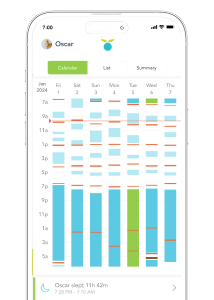
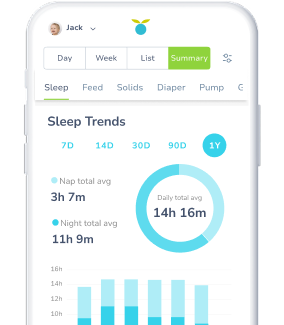
At 9 months, most babies do well with around 14 hours of total sleep: 11 - 12 hours at night and 2 - 3 hours across 2 naps. Wake windows often run 2.75 - 3.5 hours. Emerging motor milestones like crawling and pulling to stand can temporarily disrupt sleep while your baby practices these skills.
Read the full guide →If new movement and skills have gotten in the way of sleep, with a Huckleberry Premium membership, you can get a personalized sleep plan built around your baby's current patterns and your parenting preferences.
At 9 months, most babies are solidly on a 2-nap schedule with longer wake windows. Here's a sample day, though your baby's timing will shift depending on their morning rise time and wake windows.
Most babies are crawling in some form and many are pulling to stand. The pincer grasp is getting precise enough to pick up small objects, like puffs. Babies are also starting to attach meaning to words like "mama" and "dada," copy movements and sounds, and express their feelings more clearly.
Read the full guide →Have questions about your baby's development? With a Huckleberry Premium membership, Berry — Huckleberry's expert-vetted, in-app AI — is available 24/7 to help you think through what's typical at 9 months and what's coming next.
Every baby develops on their own timeline, but here are the milestones most 9 month olds hit. Use it as a gentle guide, not a checklist to stress over.
At 9 months, babies typically eat 4 - 6 milk feeds (breast milk or formula) per day as well as 2 - 3 solid meals. Finger foods are becoming a bigger part of meals as the pincer grasp develops.
Read the full guide →Track what your baby is eating — including new allergens and finger foods — in the Huckleberry app's Feeding Log. It's a helpful record for doctor visits too.
Breast milk or formula is still the primary nutrition source at 9 months. Solid meals are building toward 3 a day, and finger foods are becoming a larger part of each meal.
The developing pincer grasp makes 9 months a great time to encourage more self-feeding. Offer soft finger foods, like small pieces of cooked vegetables, ripe fruit, or shredded protein. It builds independence and supports fine motor development too.
From nap shifts to new foods and increasing mobility, things can change fast at this age. Over 6 million families use Huckleberry to track it all and get guidance made for their child.
Try Huckleberry Premium