Safe sleep for twins: A guide for new parents
Updated Sep 03, 2026
Up-to-date
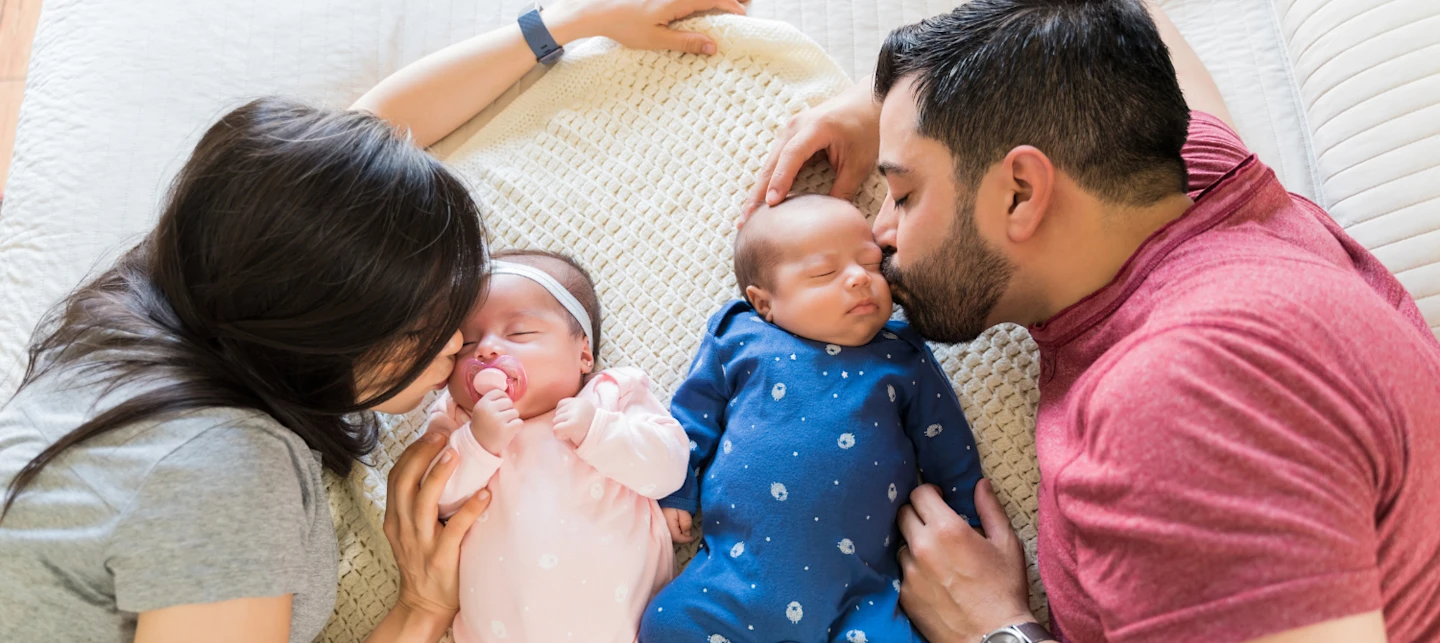


Bringing home twins means doubling up on just about everything, including questions about sleep. Many twin families also navigate one more transition: about 43% of multiples spend time in the NICU before going home, compared to 9% of singletons [1]. Going from that level of monitoring to home can feel daunting, and getting safe sleep set up at home is one concrete way to feel confident you’re doing everything you can for your babies. Safe sleep is the foundation that supports healthy rest for everyone. This guide covers the latest safety guidelines on twin sleep arrangements, how to handle naps and night wakings with multiples, and when to adjust their setup as they grow.
Can newborn twins sleep together?
Each twin needs their own separate sleep space and surface. While it can feel more practical — or even more comforting — to have twins sleep in the same space, the American Academy of Pediatrics (AAP) recommends that each baby sleep alone on their own firm, flat surface to reduce the risk of Sudden Infant Death Syndrome (SIDS). The AAP’s guidance applies to all infants, including twins and higher-order multiples [2].
This recommendation matters even more for twins because many are born preterm or at a low birth weight, both of which can raise baseline SIDS risk. Babies under 4 months old (using adjusted age if your babies were born early) are also at higher risk overall, which makes the early newborn weeks an especially important time for safe sleep practices [2].
Safe sleep arrangements for twins
In most twin households, safe sleep means two separate cribs or bassinets in the parents’ or caregivers’ bedroom. Room-sharing (but not bed-sharing) is recommended by the CDC and AAP for at least the first 6 months and ideally through the first year — and for twin families especially, having both babies close can make those frequent early night feedings significantly more manageable [3].
What a safe twin sleep setup looks like
In practice, this usually means two separate cribs or bassinets placed in the parents’ or caregivers’ bedroom.
Current safe sleep guidance includes:
A firm, flat mattress with only a fitted sheet
Keeping the sleep space clear: no pillows, blankets, bumpers, or stuffed toys
No inclines, wedges, or positioners of any kind
Products marketed to twin parents
Not every product marketed to twin parents is a concern — but some products try to make a shared sleeping space safer for twins, such as crib dividers, wedges, and positioners. However, the AAP and Safe to Sleep campaign advise against these [2, 4].
Many of these products don’t meet federal safety standards. And adding anything to a crib, even something designed to separate babies, can increase the risk of suffocation or entrapment.
When it comes to sleep, there’s no twin-specific gear that safely improves on the basics – the safest option is simply two separate sleep surfaces that meet CPSC standards, like two bassinets or two cribs, rather than products designed to hack one sleep space into two. Check out the latest Consumer Product Safety Commission (CPSC) standards to ensure your babies’ sleep setup is safe and sound.
Handling night feedings with twins
Two bassinets, pack-n-plays, or even cribs near your bed work well in the early months – and proximity matters most when night feedings are frequent. Night feedings can become one of the biggest puzzles of the early months with twins. A few approaches twin families use to find a sustainable rhythm include:
Feeding both babies at the same time: Waking both twins together can cut down on total nighttime wakings, though it only works if the second baby isn’t too sleepy to feed effectively.
Splitting the night in shifts: One caregiver takes the first half of the night, the other takes the second.
One parent per baby: Each caregiver takes responsibility for one twin for the full night in a two-parent household.
The shift approach and the one-parent-per-baby approach both work especially well for families feeding with formula or pumped milk, since either caregiver can handle a complete feeding. If you go the one-parent-per-baby route, consider rotating which baby each parent takes from night to night. That way, both infants get comfortable being settled by either caregiver.
For nursing families, dividing up the surrounding tasks (getting the baby up, burping, diaper changes, resettling) lets the nursing parent focus on the feeding while everyone gets back to sleep as quickly as possible.
If you’re navigating nights solo, the same principle applies: whatever system allows everyone the most rest while keeping your babies safe is the right one. There’s no single right system, and what works in week two may need adjusting by week eight as you find your flow.
When to adjust your twins’ sleep setup
As your babies grow and your family’s needs change, you’ll likely make a few transitions along the way. Here are the main ones that twin parents and caregivers tend to navigate.
Moving from bassinets to cribs
Most babies outgrow their bassinet between 4 and 6 months (adjusted age), though it can happen earlier or later depending on your babies and the bassinet’s weight and length limits. Signs it’s time to make the switch include:
Your baby reaches the manufacturer’s size cutoff
They’re starting to push up onto their hands and knees
Your baby starts rolling
With twins, this transition often happens around the same time for both babies — but not always. It’s fine to move one twin to a crib before the other if they reach milestones at different times.
Moving twins out of your room
The transition out of your room often overlaps with the bassinet-to-crib move. Around the same time your twins are outgrowing their bassinets, many families are also starting to think about shifting them to their own room.
The AAP recommends room-sharing for at least the first 6 months to support safe sleep. Once your twins have reached this milestone – using their adjusted age if they were born early – , you can generally begin considering this transition, depending on what feels right for your family and household space. When you make this transition is largely a personal call, and many families wait until 6 months or longer. If you’re considering a move earlier than that, discuss your plans with your pediatrician first.
For twins sharing a room together, there’s something to look forward to as they grow: hearing them babble back and forth and eventually talk to each other in the early morning before anyone else is up. For some parents, knowing the babies aren’t alone in their own room is its own kind of comfort.
Moving twins to their own separate rooms
Some twin parents eventually wonder whether their twins would sleep better in separate rooms. It’s a common question, especially when one twin’s wakings seem to disturb the other.
In reality, most twins are remarkably good at sleeping through each other’s noise. Crying, fussing, and even full-on wakings often don’t disturb the other twin as much as parents and caregivers may expect. Before separating twins to address a sleep issue, consider whether something else might be going on — such as a need for a schedule adjustment.
That said, separate rooms can make sense for some families, especially as twins get older, develop different sleep needs, or simply want their own space. There’s no specific age at which this happens. Separate rooms can absolutely be the right call — but many twin families find that the twin bond makes sharing a room something special, well into toddlerhood and beyond.
Naps with twins
Naps with twins are when caregivers tend to feel the daytime crunch – and predictable naps aren’t just about getting a break. When you know your babies are sleeping safely in their own spaces, those windows become easier to use, whether that means resting yourself or getting the dishes done and put away. With two babies on potentially different rhythms, getting any kind of break can feel impossible without a plan.
Some twin families find their babies naturally fall into different rhythms, and that’s completely workable. For families craving more structure, syncing nap schedules can be worth working toward — though even that comes with caveats depending on how old your babies are.
Syncing your twins’ nap schedules
For families who want more structure, syncing nap schedules can make a meaningful difference – synced naps mean longer stretches of downtime for caregivers, and more predictable feeding windows too. Many twin families find that bringing in a consistent morning wake time, even earlier than you might with a singleton, can make synced naps easier to establish. Waking both babies at roughly the same time each morning anchors their day. If one twin sleeps significantly longer than the other during a nap — say, 20 to 30 minutes past when the first twin wakes — gently waking the longer sleeper can help keep their rhythms aligned.
Reading each baby’s sleepy cues
Even on a synced schedule, twins are individuals – and knowing each baby’s cues is actually what makes the synced schedule workable. You’re not ignoring their differences; you’re using them.
Watching each baby’s individual sleepy cues — yawning, eye-rubbing, zoning out, increased fussiness — helps you respond to who they actually are rather than treating them as a unit. Over time, you’ll likely notice patterns like:
Which twin tends to need an earlier nap
Which one fights sleep longer
Which baby sleeps a little easier on any given day
The better you know each baby’s individual cues and needs, the easier it can become to find the balance that makes a synced schedule work for both of them.
Logging each baby’s sleep separately can make it much easier to spot individual patterns and find the overlap.
Share article:

Note: The content on this site is for informational purposes only and should not replace medical advice from your doctor, pediatrician, or medical professional. If you have questions or concerns, you should contact a medical professional.
4 Sources
Share article: