Baby's first bath: how and when to give baby their first bath at home
Updated Oct 09, 2026
Up-to-date


Many new parents wonder when to give their baby's first bath at home and what that first splash is actually supposed to look like. We’ll let you in on a little secret: newborns need far less bathing than most people expect.
In this article, we'll discuss what to expect with first baths at the hospital vs. at home, the difference between sponge baths and tub baths, and how to prepare for your baby's first bath at home. Plus, we’ll help you set some realistic expectations for how often newborns need to be bathed and what that first bath is actually like.
When do parents usually give a baby their first bath?
Timing for a baby's first bath varies, and a bath is not a requirement to go home from the hospital or birthing center.
Some hospitals bathe babies shortly after birth, while others (following updated guidance) wait longer to protect skin-to-skin bonding and early breastfeeding [1]. You, as the parent, can also have a say in this. You can ask the nurses or providers around you to hold off on bathing your baby, or to help teach you how to bathe your little one.
In the hospital or birthing center, a baby's first bath is typically a sponge bath, while tub baths are generally done at home once the umbilical cord stump has fallen off and the area has healed. (More on this below.)
Once you are home, the timeline is largely up to you and your baby's needs, whether or not they received their first bath before leaving the hospital or birthing center.
Common approaches for a first newborn bath include:
Waiting until after returning home from the hospital: Some parents skip the hospital bath entirely and give the first bath once they're settled at home.
Delaying the first bath for a short period: The World Health Organization recommends waiting at least 24 hours after birth, or a minimum of 6 hours if a full day isn't possible. (More on why this is recommended below!) [2].
Following hospital or provider guidance: Your delivery team or your baby’s medical provider may have a specific recommendation based on your baby's birth and health.
Choosing a time when you feel ready: There's no prize for an early bath — a parent who feels confident and unhurried tends to help bath time go more smoothly for everyone.
Newborn first bath at home vs. hospital bath
Some babies get their first bath from hospital staff before discharge. Others have their first-ever bath at home, days or even weeks later. Neither path is the right one, but they do come with different experiences. If your little one’s umbilical stump hasn’t fallen off yet, this will be a sponge bath no matter where it’s done.
| Hospital or birthing center | At home |
Who gives the bath | Nursing staff, often with parents watching or assisting or vice versa | Parents, often solo and without a professional coaching them through it |
Timing | Anywhere from shortly after birth to just before discharge, depending on hospital policy and parent preferences | Whenever you and your baby feel ready — hours or even days later |
Supplies | Provided by the hospital | Yours to gather: towels, washcloth, mild cleanser, and a warm room |
What parents often feel | Reassured by having a professional nearby | A little nervous the first time, but more in control of the pace |
Sponge bath vs. tub bath for the first bath
Newborns typically start with sponge baths and move to tub baths once the umbilical area has healed. A sponge bath is exactly what it sounds like: your baby stays dry and wrapped while you clean them section by section with a damp washcloth. They are never actually placed in water. It's the go-to option for the early newborn period, since it keeps the umbilical cord stump dry so it can heal.
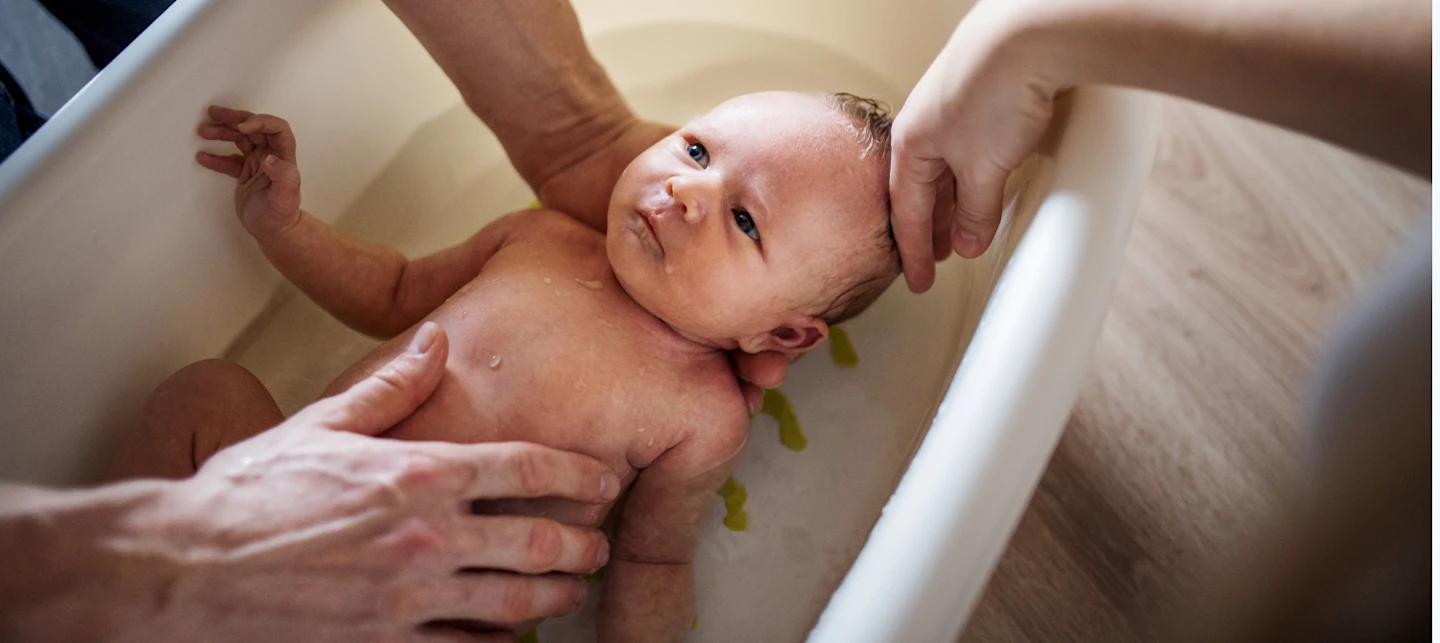
A tub bath comes next, once that stump has fallen off. This is the more traditional bath most people picture, with the baby undressed and lowered into a few inches of warm water in a safe infant tub. It takes a bit more setup and a watchful eye.
| Sponge bath | Tub bath |
When it’s commonly used | Early newborn period, until the umbilical cord stump falls off | After the cord stump falls off and the area is healed |
Supplies needed | Basin of warm water Damp washcloth Dry towel | Safe infant tub or caregiver holding baby in the bath, 2 inches of warm water Washcloth Dry towel |
Where baby stays | Fully dressed or wrapped, on a flat, padded surface — never submerged in water | Undressed and gently lowered into the water in a supported, reclined position placed directly in the water |
Typical duration | A few minutes, uncovering only the part being washed | Short and gentle, especially the first few times |
Safety focus | Keeping baby warm and the umbilical area dry | Constant touch supervision, checking water temperature, and ensuring the bathtub you’re using is age-appropriate (since a newborn can’t hold their head up yet) |
When is it okay to give a newborn their first bath?
Readiness for a newborn's first tub bath tends to come down to a few practical factors rather than a fixed date on the calendar.
Umbilical cord stump status: Until the stump falls off, stick to sponge baths so the area can stay dry and heal.
Baby's overall comfort: A baby who's fed, calm, and not overtired will usually tolerate a bath better than one who's already fussy.
Home environment and warmth: A warm room (newborns chill quickly) makes the whole process easier on everyone.
Parental confidence and support: Having a second set of hands, or at least a calm few minutes, can make a first bath feel far less nerve-wracking.
Reasons people wait for a newborn’s first bath
Why does everyone keep telling me to wait? It's a fair question when you're eager to get your baby cleaned up and into a cozy outfit. The truth is, holding off on that first sponge bath gives your newborn's body a little extra room to adjust to life outside the womb.
Some families also have cultural reasons for delaying, or starting, their little one’s first bath. All of that is OK too! Whatever brings you to a delayed bath, here's the science behind why so many providers now recommend it:
Your baby is still figuring out how to stay warm
Regulating body temperature is a brand-new skill right after birth. Unlike adults, newborns lose heat quickly because they have a larger body surface area relative to their size [3].
Those first hours are for bonding
Time spent skin-to-skin helps stabilize your baby's heart rate, breathing, and temperature. Plus, it tends to set early feeding up for success if you choose to breastfeed [4].
Vernix is doing a job
Many babies arrive with a coating of vernix, the waxy, white film that cushioned their skin in the womb. It doesn't stop working the moment your baby is born; left alone, it keeps moisturizing and guarding delicate newborn skin [5].
How to prepare for baby's first bath at home
You don't need much to pull off a smooth first bath — just a few things gathered ahead of time and a plan for who's doing what. A little prep goes a long way toward making the experience feel manageable, especially when you've never done this before.
Gather towels and clean clothes before you start: This will help you easily wrangle the wet, squirming newborn in your arms.
Check room warmth: A warm bathroom or bedroom helps prevent your baby from getting cold once they're undressed.
Fill the water in advance: 2 inches is plenty for a newborn. Check the temperature against the inside of your wrist or elbow. It should feel warm, not hot [6]. There are also affordable baby bath thermometers one can use for extra reassurance.
Keep supplies within reach: It should all be easy to grab while your hand is still on your little one: washcloth, mild cleanser (if using one), washcloth for the face, and a towel you can wrap baby in the moment the bath ends.
Grab a partner if you need to: A first bath is a lot easier with 2 sets of hands — 1 to hold and support your baby, the other to wash, reach for supplies, or grab a dropped towel. This could be another parent, a friend, or an additional family member.
What to expect during baby's first bath
It’s common for first baths to not go exactly how you planned or pictured it. Some brief fussiness or crying is common as your baby adjusts to a new sensation, and a lot of babies startle the moment they're first lowered toward the water. Don't expect a long, leisurely soak either. First baths are usually short, often just a few minutes, which is plenty of time!
Once it's over, your baby will need extra warmth right away, since newborns lose heat fast once they're wet. It’s important to keep a towel within arm's reach the whole time.
If your baby protests more than expected, it's fine to pause, dry them off, and try again another day.
How often newborns need baths
Newborns don't need daily baths. In fact, bathing too often can actually work against you. Frequent baths can strip natural oils and lead to dryness [7].
A few times a week is plenty. Most babies only need around 3 baths a week during the first year, especially during the newborn period [8]. On the days in between, a damp cloth is all you need to keep your baby's face, neck, and diaper area clean. (Sometimes those cute leg rolls also need an extra wipe!)
If bathing becomes part of your family’s routine later on, it’s OK to bathe your baby more often! The calming ritual and cozy snuggles afterward can be a special part of winding down together. If you choose to bathe more frequently, consider skipping soap or shampoo on some days to help protect your little one’s skin.
When to ask your pediatrician about baby's first bath
Most first-bath questions are about timing and comfort, not medical concerns. Still, it’s worth double-checking with your baby’s medical provider before you give your little one a bath if the following applies:
Umbilical cord concerns, such as redness, swelling, odor, or discharge around the stump
Skin irritation or rashes that don't improve or seem to be getting worse
Premature birth or medical conditions that might change standard bath timing or technique
Uncertainty about bath timing or methods — there's no such thing as too small a question when you're still getting to know your baby
Share article:

Note: The content on this site is for informational purposes only and should not replace medical advice from your doctor, pediatrician, or medical professional. If you have questions or concerns, you should contact a medical professional.
8 Sources
Share article: